
Research and testing
Investigate. Measure. Learn.
Controlled research, exploratory testing and practical evaluation in sport. Each investigation has its own methods and limits.
In progress
NIH-funded research
A Phase I STTR award supports work with Massachusetts General Hospital collaborators. A randomized crossover study will compare recovery following controlled heat exposure, with and without Kühler.
Outcomes include core body temperature, heart rate, skin temperature, thermal comfort, fatigue and usability. No completed efficacy findings are reported here.
Full research announcementPractical pilot
AO StartUps
An ongoing pilot with elite developing athletes at Tennis Australia's National Tennis Academy gathers practical feedback from athletes and coaches.
This is a field evaluation, not tournament sponsorship or a completed efficacy trial.
Full pilot announcementPreliminary descriptive observations
Exploratory push-up testing.
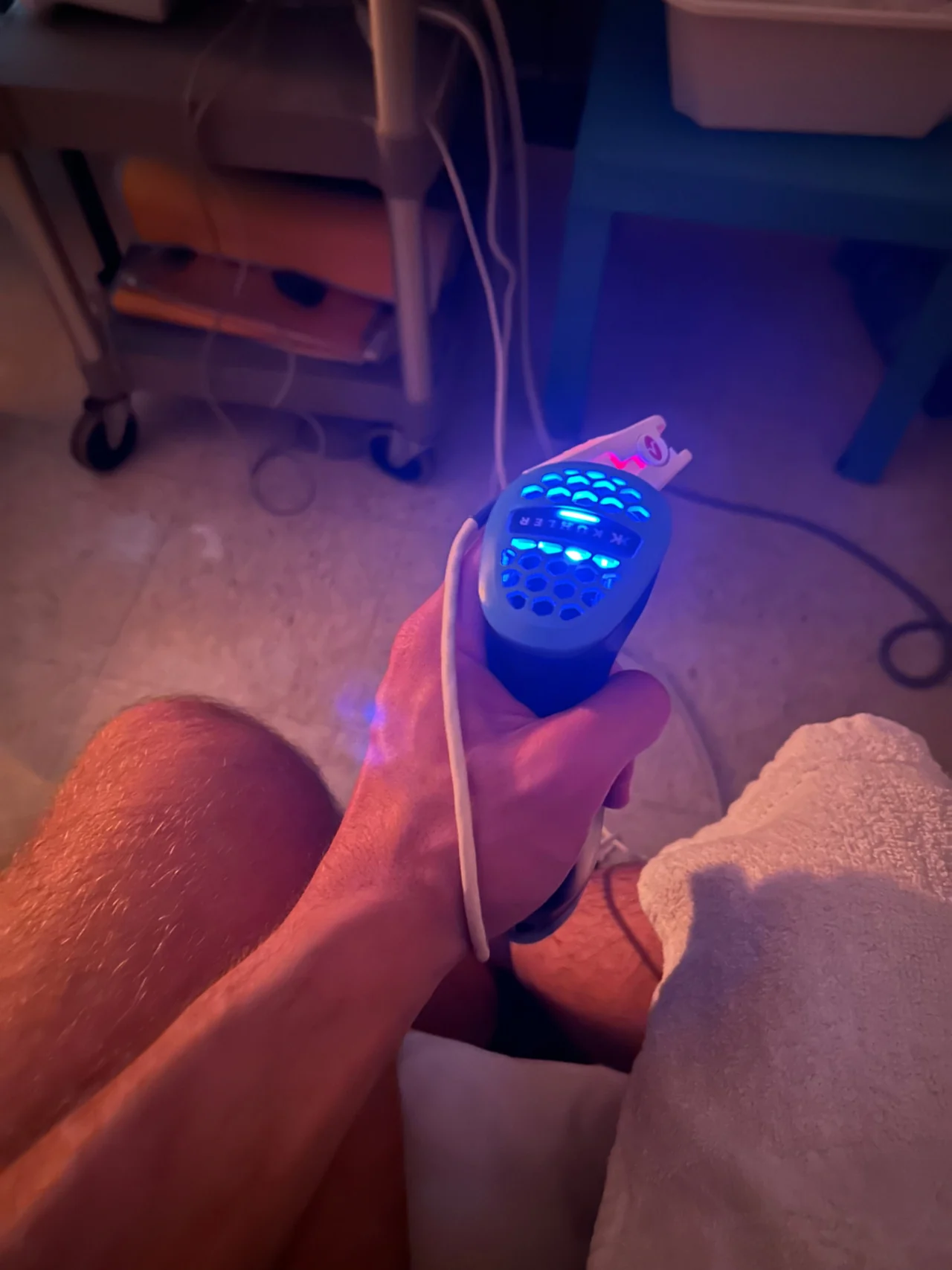
Two trials used ten sets of push-ups to failure, with fixed 120-second rests. Sets 5, 7 and 9 were no-cooling comparators; sets 6, 8 and 10 used cooling during rest. Trials used one device and two devices respectively.
The source reports repetition increases of 20%, 32% and 38% in the one-device trial, with a reported 28% aggregate increase. The two-device trial reports 37%, 24% and 47%, with a reported 35% aggregate increase. Each comparison is with the preceding no-cooling set, not a randomized parallel control.
Both trials were founder self-tests involving one participant. Randomization, blinding, variability and statistical tests are not reported. The design does not establish causality, confirm heat stress or central fatigue, or demonstrate superiority of two devices.
Preliminary temperature estimates
Exploratory post-sauna observations.
Two consecutive-day trials used approximately 87.9°C / 190°F sauna exposure for 30 minutes and 30 minutes of recovery. The first trial used no cooling; the second used two Kühler devices immediately after exposure. Temperature was estimated by a CORE wearable sensor, greenTEG, rather than directly measured with an internal probe.
The source reports peak temperature rises of +0.66°C with cooling versus +0.88°C without; recovery-period rises of +0.16°C versus +0.67°C; and peak-rise rates of +0.035°C/min versus +0.056°C/min. Reported relative differences of 25%, 76% and approximately 37% are changes in these measurements, not percentage reductions in body temperature or recovery-speed improvements.
The no-cooling trial started at a higher temperature and remained higher. Fixed condition order, differing starting conditions, wearable estimation and unreported participant count and variability limit interpretation.
Do not reproduce this sauna protocol as a usage recommendation. These observations do not establish prevention or treatment of hyperthermia or exertional heat illness. Kühler is not a substitute for emergency assessment and established treatment.
A personal N-of-1 report
Nancy Iv’s six-week report covers January 5 to February 16, 2026. It describes 30 resistance-training sessions, 15 with Kühler and 15 without, alternating by week. Training output was logged with Ladder. Between-set heart-rate changes were measured with Apple Watch and recorded manually.
Reported mean heart-rate differences ranged from +1.8 to +6.5 bpm by workout type. This interval-dependent change is not a direct measure of heat flux or core temperature. The participant and analyst were the same person; order was not randomized, no blinded comparison was described, and sleep and nutrition were not formally controlled.
One participant’s repeated sessions are not 30 independent participants. Some arithmetic and density values in the report require author reconciliation, so headline volume percentages are not republished here. These observations do not establish a typical or causal product benefit.